Maintaining consistency at scale has become one of the biggest challenges for namkeen manufacturers in India. As demand for packaged snacks continues to grow across urban and rural markets, manufacturers are expected to manage production efficiency, freshness, distribution speed, and regional taste preferences simultaneously. Unlike many FMCG categories with standardized consumer behavior, the namkeen segment is heavily influenced by local preferences, seasonal demand, and pricing sensitivity.
For businesses operating in wholesale, retail, and distribution, supply inconsistency can directly affect retailer trust and long-term sales performance. Delayed deliveries, inconsistent taste, poor shelf life, and packaging issues often create operational pressure across the supply chain. As competition increases, namkeen manufacturers in India are focusing not only on production capacity but also on distribution efficiency and scalable operational systems.
The industry is no longer driven solely by product availability. Today, namkeen manufacturers in India must balance quality control, logistics planning, inventory movement, and changing consumer expectations while maintaining profitability across different market segments.
The Growth of the Namkeen Industry in India
The namkeen category has evolved significantly over the past decade. As demand expands, namkeen manufacturers in India are under increasing pressure to improve operational systems, strengthen supply chains, and maintain product consistency at larger production volumes. The rise of quick-commerce platforms and changing purchasing behavior are pushing manufacturers to improve supply speed and inventory efficiency across multiple markets, and changing purchasing behavior are pushing manufacturers to improve supply speed and inventory efficiency across multiple markets.
Operational Challenges Faced by Namkeen Manufacturers in India
One of the major operational challenges in the namkeen industry is maintaining consistency across large production volumes. Small variations in seasoning, frying temperature, ingredient quality, or packaging conditions can affect product taste and shelf life. Since namkeen products are highly sensitive to freshness and texture, namkeen manufacturers in India must maintain strict quality control systems throughout the production process.
Raw material dependency also creates operational instability. Ingredients such as edible oil, gram flour, peanuts, spices, and lentils are directly affected by agricultural supply fluctuations and market pricing changes. Sudden increases in raw material costs can impact production planning and profitability for namkeen manufacturers in India.
Regional demand variation creates another layer of complexity. Consumer preferences differ significantly across states and cities. In some regions, spicy variants dominate demand, while other markets prefer milder or traditional flavors. Namkeen manufacturers in India supplying across multiple regions must manage different product variations without affecting operational efficiency.
Another major challenge is inventory and supply chain management. Namkeen products move quickly through wholesale and retail networks, especially during festive periods when demand spikes sharply. Distributors often increase stocking volumes during festivals and seasonal demand cycles. Manufacturers must plan production carefully to avoid stock shortages or excessive inventory accumulation.
Retailer expectations have also changed significantly. Modern trade outlets, supermarkets, and quick-commerce platforms now expect faster replenishment cycles, attractive packaging, and consistent product availability. Delays in supply or inconsistent packaging quality can reduce shelf visibility and affect retailer relationships.
Packaging durability remains another important operational concern. Since namkeen products are sensitive to moisture and air exposure, packaging quality directly impacts freshness and shelf stability. Namkeen manufacturers in India investing in stronger packaging systems are better positioned to reduce product damage during transportation and storage.
How Namkeen Manufacturers in India Manage Large-Scale Operations
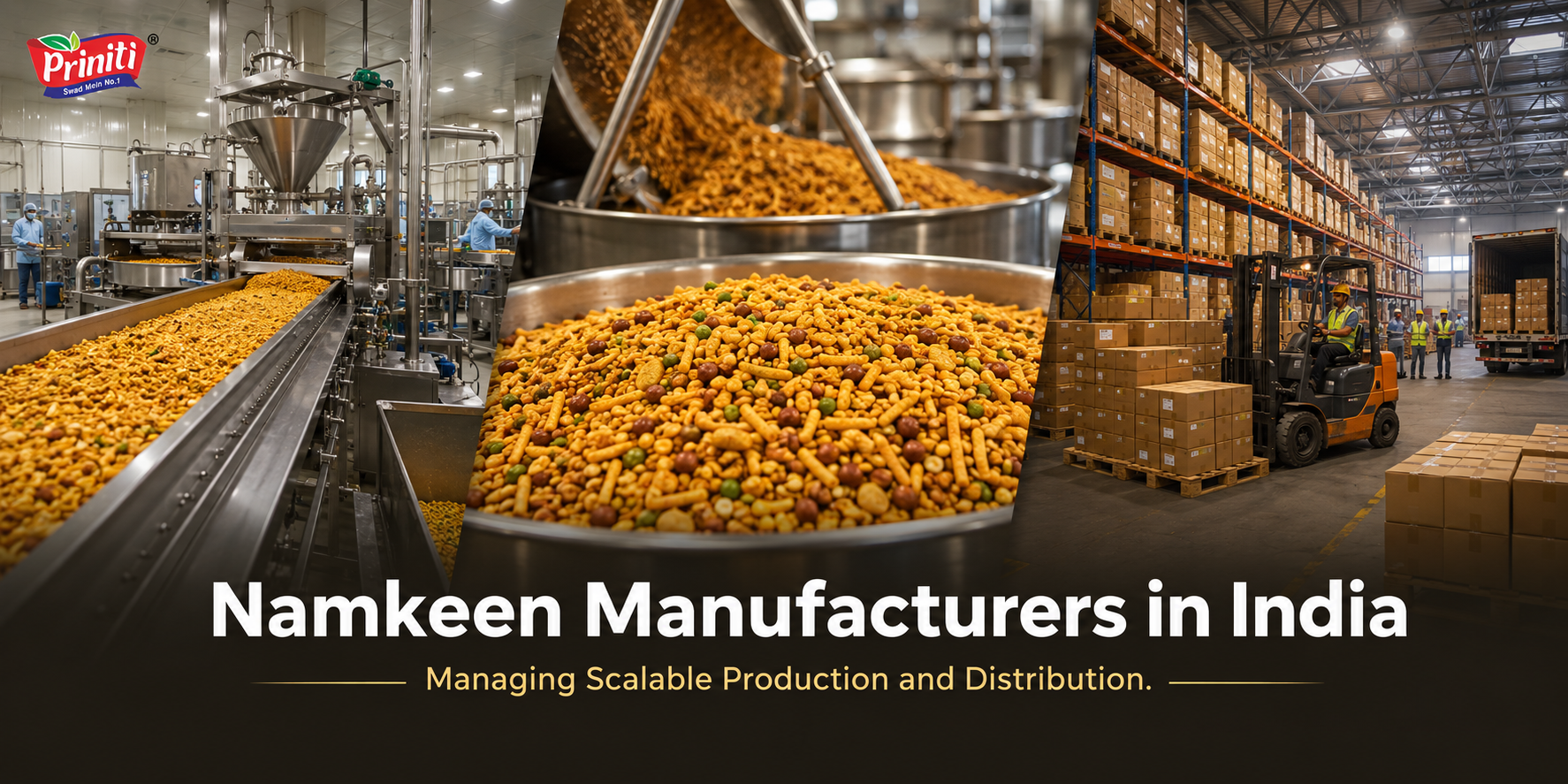
To handle growing demand efficiently, namkeen manufacturers in India are increasingly adopting structured manufacturing and distribution systems. Scalable operations now depend on production planning, automated processes, logistics coordination, and quality management rather than just increasing output volumes.
Large-scale manufacturers typically follow a layered supply chain structure:
Manufacturer → Distributor → Wholesaler → Retailer → Consumer
Each stage plays a critical role in maintaining smooth product movement across markets. Manufacturers focus on production consistency, while distributors and wholesalers ensure products reach retail points without delays.
Production planning has become an essential operational function. Many namkeen manufacturers in India now schedule production cycles based on regional demand patterns, inventory movement, and retailer purchasing behavior. This helps reduce wastage while improving supply consistency.
Many namkeen manufacturers in India are investing in automated production and packaging systems to improve efficiency and maintain consistency across large production batches. Manufacturers also use inventory management and logistics tracking systems to improve operational visibility and reduce dispatch delays.
Quality assurance systems are equally important in large-scale operations. Food safety standards, hygiene management, oil quality monitoring, and packaging inspections are now critical operational priorities. Namkeen manufacturers in India with structured quality control systems are better equipped to maintain long-term retailer and distributor trust.
Distribution planning also plays a major role in operational success. Manufacturers with stronger logistics networks can supply products faster across multiple cities and states. This becomes especially important during high-demand periods when retailer replenishment cycles become shorter.
Key Operational Factors That Impact Scalability
1. Consistent raw material sourcing and quality control
2. Efficient inventory and warehouse management
3. Strong distributor and retailer relationships
4. Production flexibility during demand fluctuations
5. Reliable transportation and logistics systems
6. Packaging durability and shelf-life management
7. Faster dispatch and replenishment cycles
8. Structured demand forecasting systems
Namkeen manufacturers in India that manage these operational factors effectively are better positioned to scale sustainably while maintaining consistent product quality.
Why Distribution Efficiency Matters in the Namkeen Industry
Distribution efficiency directly affects product availability, retailer confidence, and market expansion. Even strong products struggle to maintain sales momentum if supply systems are inconsistent.
For namkeen manufacturers in India, distribution challenges are more complex due to the country’s fragmented retail landscape. Products must move efficiently through wholesalers, distributors, supermarkets, local stores, and modern retail channels simultaneously.
In Tier 2 and Tier 3 cities, supply consistency often matters more than aggressive marketing campaigns. Retailers prefer brands that maintain stable inventory levels and timely delivery schedules. Namkeen manufacturers in India with efficient distribution planning are able to build stronger retailer relationships and improve repeat demand.
The rise of quick-commerce platforms has further increased operational pressure on manufacturers. Faster delivery expectations now require tighter inventory management and shorter supply cycles. Because of these changing dynamics, many namkeen manufacturers in India are focusing heavily on logistics optimization, regional warehousing, and faster dispatch systems to improve operational efficiency.
Market Trends Shaping Namkeen Manufacturers in India
The namkeen industry is evolving rapidly due to changing consumer preferences and expanding retail ecosystems. Traditional namkeen products continue to perform strongly, but manufacturers are also adapting to newer consumption trends.
One major trend is the increasing demand for affordable and smaller SKU packaging. Smaller packs perform particularly well in high-volume retail environments and quick-commerce platforms where convenience purchasing is common.
Health-conscious consumers are also influencing product development. Many namkeen manufacturers in India are exploring baked variants, reduced-oil products, and ingredient-focused innovations to match changing preferences.
Regional flavor innovation is becoming another major growth factor. Consumers are increasingly interested in products inspired by local taste profiles and traditional recipes. Namkeen manufacturers in India capable of balancing regional customization with scalable operations are gaining competitive advantages.
Packaging innovation is improving product presentation, shelf life, and retail visibility in competitive markets.
Export opportunities are expanding rapidly. Indian snack products are witnessing growing demand in international markets, particularly in regions with strong Indian consumer bases. Namkeen manufacturers in India with international compliance certifications are better positioned to capitalize on this demand.
How Priniti Foods Supports Scalable Snack Operations
As operational complexity increases across the snack industry, businesses are increasingly looking for manufacturing partners with scalable systems and reliable distribution capabilities. Companies like Priniti Foods are adapting to these challenges through structured manufacturing operations, quality-focused systems, and expanding distribution networks.
With over 16 years of experience in the FMCG sector, Priniti Foods has developed a strong operational ecosystem that supports consistent supply and market scalability. The company operates across multiple regions and maintains a wide distribution presence covering 12+ countries, 38 states, and 1100+ cities.
Its distribution network includes more than 2600 distributors and a retail reach of over 1 lakh outlets. This large-scale operational structure helps maintain product availability across different markets while supporting growing demand efficiently.
Priniti Foods also follows strict quality and compliance systems supported by certifications such as FSSAI, FSSC 22000, APEDA, FDA Thailand, and FDA USA. These certifications reflect strong quality standards and operational reliability.
By combining manufacturing capabilities, logistics coordination, and quality systems, Priniti Foods supports scalable snack distribution and operational consistency across multiple regions.
Conclusion
The operational demands placed on namkeen manufacturers in India continue to increase as consumer demand, retail expansion, and distribution complexity grow across the market. Success in this industry now depends not only on production capacity but also on operational efficiency, supply consistency, packaging quality, and scalable distribution systems.
Manufacturers capable of balancing production, logistics, inventory management, and changing market trends are better positioned for long-term growth. Businesses looking to scale within the snack industry must evaluate manufacturers not only on pricing but also on operational reliability and long-term scalability.
In a rapidly evolving FMCG environment, operational strength and distribution efficiency are becoming just as important as product quality for sustainable success.
FAQs
1. Why is distribution important for namkeen manufacturers in India?
Distribution ensures products reach retailers efficiently and helps maintain consistent product availability across markets.
2. What operational challenges do namkeen manufacturers in India face?
Common challenges include supply consistency, regional demand variation, packaging durability, inventory management, and fluctuating raw material costs.
3. How do namkeen manufacturers in India manage large-scale production?
Many manufacturers use automated systems, production planning, quality control processes, logistics optimization, and structured distribution networks.
4. Why does packaging matter in the namkeen industry?
Packaging helps maintain freshness, improves shelf life, and protects products during transportation and storage.
5. Can small businesses work with namkeen manufacturers in India?
Yes, many manufacturers support wholesalers, distributors, retailers, and growing businesses with scalable supply solutions.