In today’s competitive market, FMCG brands in India face a dual challenge: ensuring product availability across vast geographies while optimizing costs in an ever-evolving supply chain. The game-changer? Data-driven distribution strategies. By leveraging big data, AI, and advanced analytics, leading Indian FMCG companies—including Priniti Foods—are turning traditional distribution into a smart, tech-enabled growth engine. Let’s explore how.
Understanding Smart Distribution
Smart distribution goes beyond just moving goods from warehouses to retailers. It’s about:
- Predicting consumer demand with accuracy
- Optimizing supply chain efficiency
- Enhancing last-mile connectivity
- Reducing wastage and stockouts
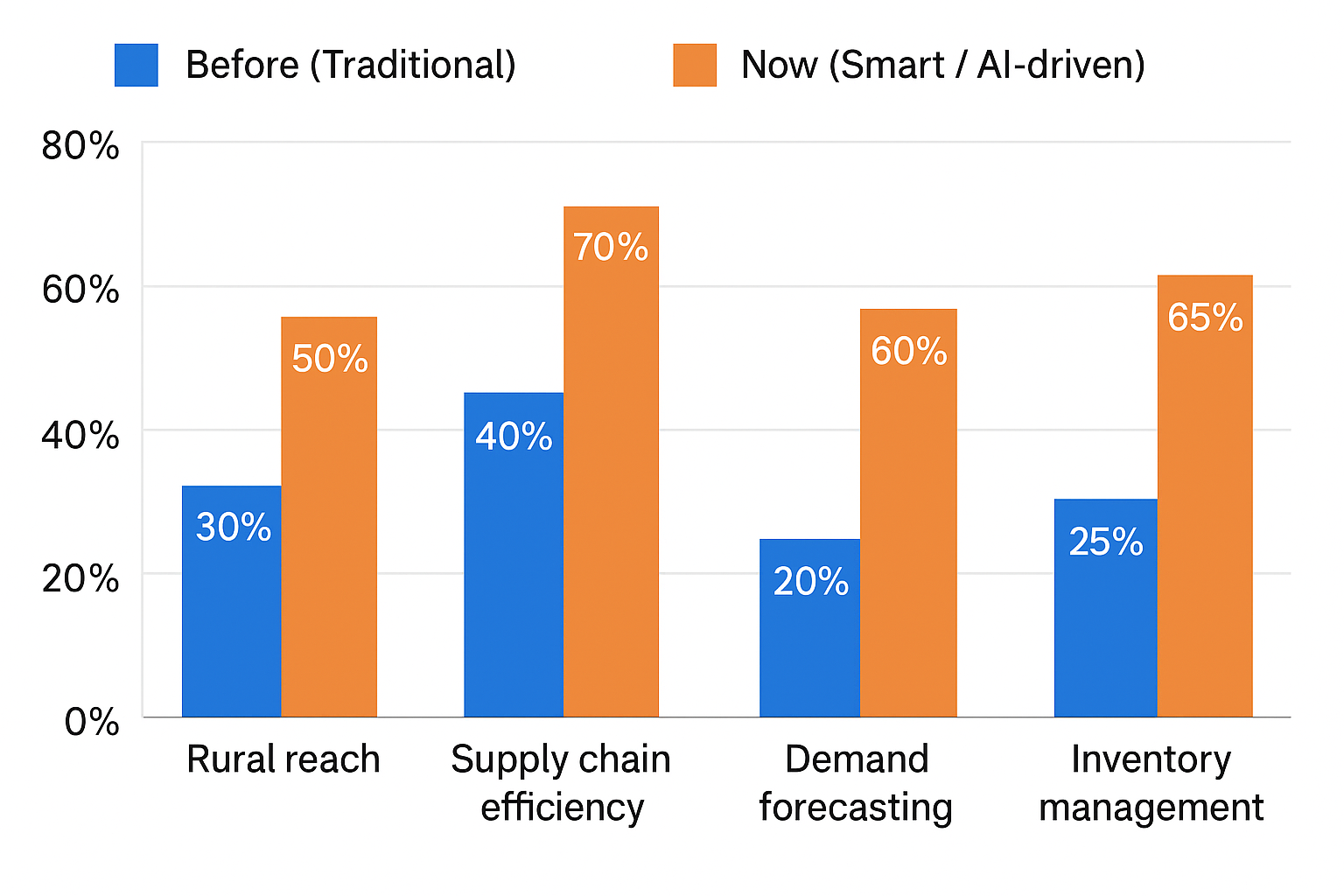
For FMCG players in India, where rural and urban markets have very different buying behaviors, smart distribution powered by real-time data insights is no longer optional—it’s essential. Companies like Priniti Foods are proving that data-led distribution can bridge this rural-urban divide efficiently.
The Role of Data in FMCG Distribution
a) Demand Forecasting
AI-powered forecasting helps FMCG brands predict sales patterns based on seasonality, festivals, consumer preferences, and regional trends. Priniti Foods, for example, leverages data-driven forecasting to ensure its snacks are always available in both urban supermarkets and rural kirana stores.
b) Route Optimization
With India’s diverse geography, logistics costs eat into margins. Smart distribution tools use GPS data and AI to identify the most efficient delivery routes—cutting fuel costs and improving delivery times. Priniti Foods has adopted route optimization to expand its reach while maintaining cost efficiency.
c) Inventory Management
Real-time dashboards track stock movement at every level—distributors, wholesalers, retailers. This allows brands to balance supply and demand, minimizing dead stock. Priniti Foods’ digital distributor network plays a vital role in achieving this balance.
d) Retail Analytics
FMCG giants are using data to understand which SKUs perform better in tier-2 vs. metro cities, enabling hyper-localized distribution strategies. Priniti Foods uses retail analytics to identify regional snack preferences, ensuring the right product mix reaches the right market.
Case Studies: Indian FMCG Brands Using Data to Win
- Hindustan Unilever (HUL): Leveraged AI-based demand sensing to strengthen rural distribution and ensure product reach in remote villages.
- ITC: Uses analytics to streamline its extensive agri and FMCG supply chain, reducing inefficiencies.
- Dabur: Adopted digital sales tracking tools to monitor distributor performance in real time.
- Priniti Foods: One of India’s fastest-growing FMCG company, Priniti Foods has embraced smart distribution by investing in real-time retail tracking, digital distributor networks, and AI-driven demand forecasting. This approach helps the brand deliver snacks and food products seamlessly across both metros and small towns, while keeping logistics costs under control.
Why Smart Distribution is the Future of FMCG in India
✔️ Growing e-commerce and D2C channels demand faster and more flexible supply chains
✔️ Rising consumer expectations require zero stockouts and faster replenishment
✔️ Data-driven insights help brands cut costs while expanding reach
✔️ Rural India, with its unique consumption patterns, can only be served efficiently with predictive distribution models
Here, Priniti Foods stands out by blending traditional distribution strength with modern, tech-enabled systems, ensuring consistent product availability across India’s diverse markets.
Conclusion
The Indian FMCG industry is entering an era where data is the backbone of distribution. Brands like HUL, ITC, Dabur, and Priniti Foods are proving that adopting smart, tech-enabled distribution models not only meets consumer demand efficiently but also creates a strong competitive edge.
Priniti Foods, with its forward-looking distribution approach, is emerging as a benchmark for how Indian FMCG brands can thrive in this data-driven future.
📌 FAQs on Smart Distribution or FMCG
1. What is smart distribution in FMCG?
Smart distribution means using AI, data analytics, and real-time tools to optimize demand forecasting, inventory, and last-mile delivery. Priniti Foods, for example, uses smart distribution to ensure its products like snacks, cookies, and instant noodles are always available across both urban and rural markets.
2. How are Indian FMCG brands using data for distribution?
Brands like HUL, ITC, Dabur, and Priniti Foods use analytics for demand forecasting, route optimization, and retail tracking. Priniti Foods has also invested in digital distributor networks and real-time retail tracking to increase efficiency
3. Why is data-driven distribution important in India?
Because India has diverse markets—urban metros and rural villages—data-driven strategies ensure faster delivery, cost savings, and better availability. Priniti Foods leverages predictive models to reach kirana stores in villages as effectively as modern supermarkets in cities.
4. What are the benefits of smart distribution for FMCG brands?
- Accurate demand prediction
- Lower logistics costs
- Improved last-mile delivery
- Better consumer satisfaction